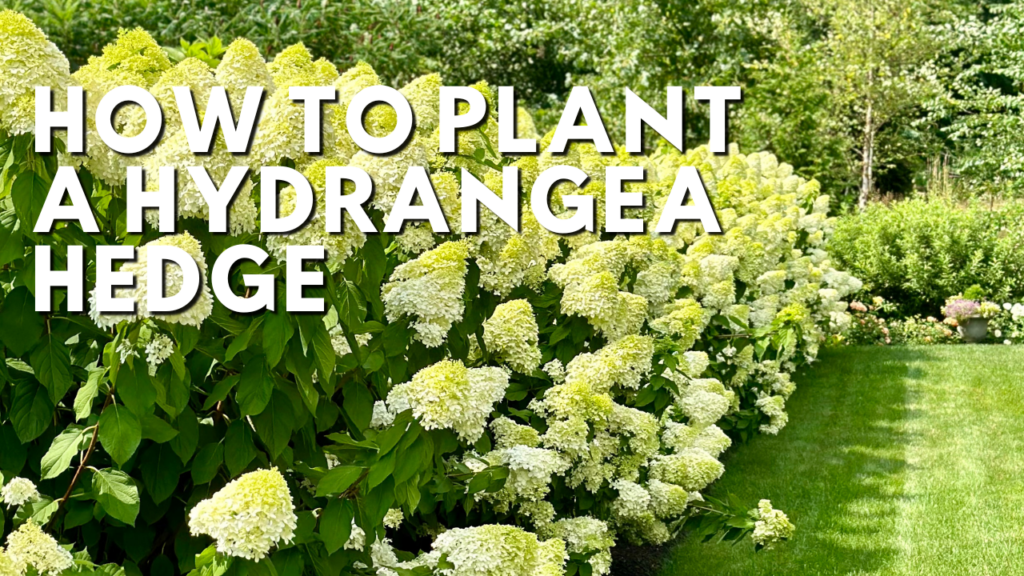
There’s something about a full row of hydrangeas that makes a garden feel instantly more established.
Whether you’re using them along a property line, foundation, walkway, or as a backdrop for the rest of your garden, hydrangeas can create an incredible hedge—but getting that full, seamless look takes a little planning.
And maybe most importantly: it takes time.
We’ve planted and grown a lot of hydrangeas in our Zone 6 garden, and if you’re planning a hedge of your own, there are a few things we’d think about before putting that first plant in the ground.
Want to save all of this for planting day?
We put our most important hydrangea hedge tips into a simple, printable guide you can keep on hand while you plan and plant.
As with almost everything in gardening, start with right plant, right place.
Hydrangeas generally perform beautifully with morning sun and some afternoon shade. Full sun can work too, especially when the plants receive consistent moisture.
What we wouldn’t recommend is deep shade. Your plants may survive, but you’re less likely to get the abundant flowering that makes a hydrangea hedge so spectacular.
You’ll also want rich, well-drained soil and enough room for the mature size of the hydrangea variety you’re planting. The goal isn’t just to make the hedge look good the first year. You’re planning for what those plants will look like several years from now.
This is probably one of the biggest questions when you’re trying to create that full hedge look.
The right spacing depends on the mature size of the hydrangea you’re planting. If you want your plants to eventually grow together into a full, seamless hedge, you’ll typically plant them a little closer than their mature width.
For example, Limelight hydrangeas can grow to about 8 feet wide, so for a full hedge, we like to plant them about 5–6 feet on center. Incrediball hydrangeas mature around 4 feet wide, so we’ll plant those about 3 feet on center for a fuller look. And for a smaller hydrangea like Let’s Dance Sky View®, spacing them about 2.5–3 feet on center can help create that same continuous hedge effect.
And when we say on center, we mean measuring from the center of one plant to the center of the next.
The important thing is to check the mature size of your specific hydrangea before you start digging. Hydrangeas can vary tremendously in size, so a compact hydrangea and a large panicle hydrangea shouldn’t automatically be planted at the same distance just because they’re both hydrangeas.
We tend to prefer slightly closer spacing when the goal is a full, seamless hedge, but you still want to give each plant enough room to grow and mature.
It’s very easy to look at those little shrubs from the garden center and think:
There is WAY too much space between these.
Give them time.
One of the biggest lessons our garden has taught us is that you have to picture what a plant will become—not just what it looks like today.
Planting too closely can eventually mean overcrowding, reduced airflow, or shrubs growing into spaces where you don’t want them.
Before planting, look at the expected mature width of your specific variety and consider how much overlap you ultimately want in your hedge.
Water is especially important while your hydrangeas establish their root systems.
During the first year, we recommend deep watering two to three times per week during dry periods. By the second year, you can generally move toward weekly watering as needed. Established plants may only need supplemental water during prolonged periods of drought.
The important word here is deeply.
A thorough soaking encourages roots to grow deeper into the soil and is much more beneficial than frequent, shallow watering.
If you’re planting an entire hydrangea hedge, drip irrigation can make consistent, deep watering much easier, especially during that important first growing season. It delivers water directly to the root zone and takes a lot of the guesswork—and time—out of keeping a long row of shrubs properly watered.
We use drip irrigation throughout our own garden, and if you’re considering adding it to your hydrangea hedge, we have a Drip Irrigation Quick Start Guide that walks you through how to get started.
This is where patience comes in.
Your hydrangea hedge probably isn’t going to look like the inspiration photo in its first summer—and that’s completely normal.
In year one, much of the work is happening underground as the root system establishes. You’ll likely get some flowers, but don’t expect perfection.
By year two, you’ll start seeing the plants fill out and usually get much heavier bloom production.
And by year three? That’s when the hedge can really start becoming a major feature in the garden.
We say this all the time, but it’s worth repeating: beautiful gardens happen over time.
We like to use a starter fertilizer when planting, a slow-release fertilizer in spring, and optional water-soluble feeding during the growing season.
What we avoid is heavy feeding late in the season.
Remember that fertilizer isn’t a substitute for getting the basics right. Appropriate sunlight, consistent water, healthy soil, and patience will do far more for your hedge than continually adding fertilizer.
If a hydrangea hedge is on your garden wish list, we’ve made it easy to keep these tips handy.
Our free Hydrangea Hedge Guide includes our recommendations for:
Once you’ve planned your hedge, there’s a lot more to know about keeping your hydrangeas healthy, identifying what you’re growing, pruning correctly, and getting the best blooms possible.
That’s exactly why we created our Hydrangea Handbook—a more comprehensive resource designed to help you grow hydrangeas with confidence.
Join our gardening journey and grow alongside us. From seed starting to full garden tours, we share tips, inspiration, and the joy of growing beautiful spaces.
We respect your privacy and will never share your information. Thanks for growing with us!
Get seasonal tips, behind-the-scenes from our garden, and be the first to know what we’re planting, pruning, and loving.
As a thank you, we’ll send you our favorite tried-and-true plants — the ones we grow in our own garden.