There’s something magical about the garden in June.
The spring bulbs have finished their show, the roses are stealing the spotlight, hydrangeas are beginning to wake up, and all of those design decisions we made months ago are finally starting to come together. It’s one of our favorite times of year because the garden begins to feel less like a collection of individual plants and more like a complete landscape.
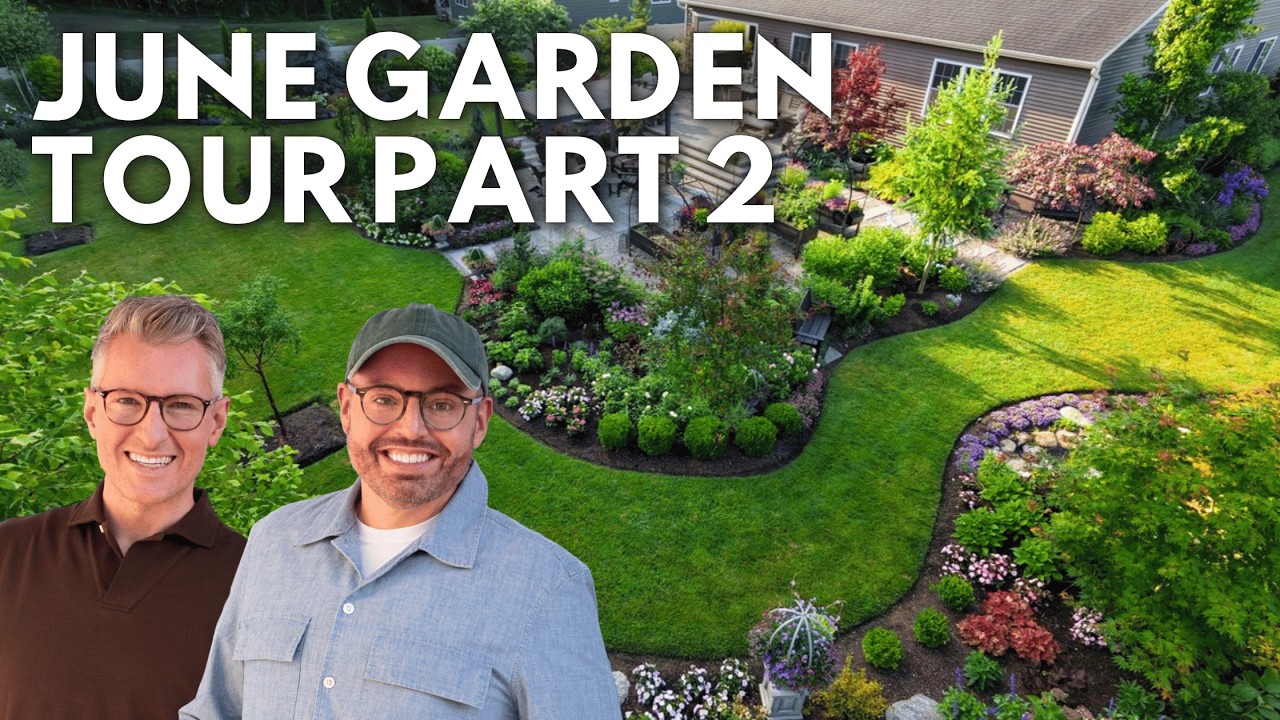
In this second part of our June garden tour (check out part one here!), we’re taking you through the front gardens, west side borders, pondless waterfall, berm plantings, and terrace to share what’s thriving, what surprised us after this past winter, and a few changes we’re already planning for next season.
If you’re looking for ideas for layering shrubs, designing containers, combining colors, or choosing plants that provide interest throughout the growing season, we hope you’ll find plenty of inspiration.
One of our favorite moments this season is greeting visitors before they even step out of the car.
Our front entry containers have really settled in over the past month, and we couldn’t be happier with how they’ve matured. The centerpiece is a fragrant ‘Carding Mill’ standard rose, whose warm coral blooms immediately draw your eye and perfume the entire driveway. After cutting a few stems to bring indoors, we quickly remembered why this has become one of our favorite roses.
To soften the transition between the tall rose and the lower annuals, we planted Meteor Shower® verbena, whose airy purple flowers create a beautiful bridge between the different layers.
Below that, the containers are filled with a colorful mix of annuals including:
One of our favorite design tricks this year was using a small shrub as a foliage plant instead of relying solely on annuals. The dark variegated foliage of the loropetalum adds structure and contrast that should only improve as the season progresses.
Perhaps the biggest improvement, though, isn’t something you’ll immediately notice.
For the first time, these containers are connected to drip irrigation, and the difference has been remarkable (check out our post on drip irrigation here for how to set up your own system!). Consistent watering has encouraged healthier growth, fuller plants, and far less stress during hot stretches of summer.
Sometimes the biggest garden upgrades happen behind the scenes.
As we continue around the front gardens, you’ll notice one design principle repeated over and over: repetition.
Rather than filling every space with something completely different, we intentionally echo plants throughout the landscape.
Winter Gem boxwoods balance each side of the driveway.
Fire Light Tidbit® hydrangeas repeat near the foundation.
Catmint appears throughout multiple beds.
Meteor Shower® verbena pops up again and again to add movement.
Those repeated elements quietly connect each section of the landscape, making the entire garden feel intentional rather than like a collection of individual planting beds.
It’s one of the easiest professional design techniques to borrow for your own garden.
Several plants are beginning to settle into their permanent roles after another challenging Upstate New York winter.
Our Jane magnolia is slowly being trained into a tree form, something we’ve admired in several local gardens. Every season we continue limbing it up a little more, allowing its beautiful branching structure to become part of the design.
Nearby, our Hinoki cypress “green wall” is filling in beautifully and beginning to provide the evergreen backdrop we envisioned when planting it.
We also relocated several Sweet Romance® lavender plants from an area that stayed too wet. Their new location receives excellent drainage and much drier conditions, and they’re already looking significantly happier. It’s a great reminder that sometimes moving a struggling plant is much easier than trying to force it to thrive where it isn’t happy.
Not every plant escaped the winter unscathed, though.
Our Burk’s Red variegated pine lost its central leader during one of the coldest winters we’ve experienced in years. Fortunately, it’s already showing encouraging signs of recovery, proving once again that patience is often one of the most valuable gardening tools we own.
As the front landscape transitions toward the side garden, fragrance becomes just as important as flower color.
Walker’s Low catmint welcomes visitors with its long-lasting lavender-blue blooms while also helping discourage deer from browsing nearby plants. Behind it, the richly fragrant ‘Gabriel Oak’ David Austin rose provides another layer of color and scent during peak bloom season.
Just beyond that, our Little Quick Fire® standard hydrangea has become one of our favorite new additions.
Underplanted with Let’s Dance Can Do!® reblooming hydrangeas, this combination has really impressed us this season. After dying completely to the ground during our unusually harsh winter, the shrubs have returned with a noticeably tidier, more compact habit than last year. Instead of battling old stems and uneven growth, they’re producing fresh new shoots that create a cleaner overall shape.
Sometimes winter gives us an unexpected reset.
Nearby, Limelight Prime® hydrangeas continue to anchor the bed beneath our Shiloh Splash® river birch, whose creamy variegated foliage seems to glow whenever the afternoon sun filters through the branches.
One of our favorite color combinations in this area pairs the bright foliage of Sun King aralia with the silvery blue needles of our Vanderwolf pine. The contrast between chartreuse and blue never fails to catch our attention, and it becomes even more dramatic as the surrounding perennials continue filling in throughout the summer.
These moments of contrast—mixing foliage colors, textures, heights, and bloom times—are what transform individual plants into a garden that remains interesting long after the flowers have faded.
One of the most exciting parts of this year’s June garden tour is seeing just how much the west garden has matured.
While many of these beds are still relatively young, they’re already beginning to feel established. The shrubs are filling in, the perennials are weaving together, and the layered plantings are creating exactly the cottage-style look we envisioned when we first put them on paper.
Of course, Mother Nature had a few surprises for us this year.
Like many gardeners across colder climates, we experienced an unusually harsh winter. Several plants died completely to the ground, others suffered significant dieback, and a few didn’t survive at all. Even so, we’re incredibly encouraged by how much of the garden has bounced back in just a few short months.
Sometimes a difficult winter teaches you more about your garden than an easy one ever could.
If you’ve followed us for any length of time, you know we have a soft spot for David Austin roses—and June is when they truly begin to shine.
Throughout this section of the garden, roses are paired with companion plants that help extend seasonal interest while supporting pollinators and adding texture after the first flush of blooms has passed.
Some of our favorites this season include:
Rather than planting roses on their own, we like surrounding them with long-season perennials like catmint, alliums, verbena, and salvia. These companion plants soften the base of the roses, fill empty spaces between bloom cycles, and provide valuable nectar for bees and butterflies throughout the season.
It’s one of the simplest ways to make a rose garden feel more natural and less formal.
One thing we’ve noticed throughout the entire garden this year is just how resilient many of our hydrangeas have been.
Several varieties that completely died back over the winter have already produced vigorous new growth, and some are looking even better than they did last season.
We’re especially excited to watch:
It’s also been fun experimenting with soil amendments to influence flower color.
For some of our blue mophead hydrangeas, we’ve been applying a bluing fertilizer to encourage deeper blue blooms. While the color changes take time, we’re already seeing promising results, and we’ll continue sharing updates as the season progresses.
One of our favorite things about gardening is treating it as an ongoing experiment. Sometimes those experiments work beautifully. Sometimes they teach us something new for next year.
Either way, we learn.
Want a more in depth look at how to grow and design with your hydrangeas? Check out our Hydrangea Handbook here!
As this side of the garden has expanded, we’ve become even more intentional about repeating plants throughout the landscape.
Rather than introducing something new in every planting bed, we continue returning to a handful of favorites.
Meteor Shower® verbena appears again and again, creating soft movement above neighboring plants.
Catmint is repeated throughout the borders, adding months of lavender-blue blooms while helping deter deer.
Supertunia Mini Vista® annuals provide ribbons of consistent color that connect separate garden spaces.
Evergreen shrubs are echoed throughout the landscape to provide year-round structure, while chartreuse foliage from plants like Sun King aralia brightens shadier corners.
This repetition helps the eye move naturally through the garden and creates a landscape that feels cohesive instead of busy.
One thing we pay close attention to isn’t just bloom color—it’s foliage color.
Some of our favorite combinations this year have very little to do with flowers at all.
The rich burgundy foliage of our purple beech creates beautiful contrast against the bright greens of nearby Japanese maples.
Golden arborvitae and chartreuse perennials light up darker corners of the garden.
Silvery-blue conifers provide year-round structure while making neighboring pinks, purples, and whites appear even more vibrant.
When you’re designing a garden, remember that flowers are temporary.
Foliage is what carries your design for the majority of the growing season.
That’s why we spend just as much time thinking about leaf color, texture, and plant habit as we do flower color.
Not every plant has been a success—and that’s okay.
Some lavender struggled because the area stayed wetter than we’d anticipated. Rather than trying to force it to work, we moved those plants into much drier locations where they’re already performing better.
A few conifers experienced winter damage but are slowly recovering.
Several newer hydrangeas are still proving themselves, and we’ll continue evaluating whether they’ve earned a permanent place in the garden.
One vigorous clematis may even get replaced next season after completely overwhelming its support.
That’s one of the realities we don’t think gets talked about enough.
Gardens are never truly finished.
They’re constantly evolving as plants mature, conditions change, and we discover combinations that work even better than what we originally imagined. We don’t see those changes as mistakes—we see them as opportunities to keep refining the landscape each year.
If there’s one thing this garden continues to teach us, it’s that patience really does pay off.
Many of the plants that looked tiny just a year or two ago are beginning to knit together, soften hard edges, and create the layered landscape we’ve been envisioning from the beginning.
We’ve also learned not to be discouraged by setbacks.
Harsh winters happen.
Plants occasionally disappoint us.
Sometimes we move something three times before it finally finds the right home.
That’s gardening.
Every season gives us another opportunity to observe, learn, and make the garden even better than it was the year before.
We hope this June garden tour gave you a few ideas for your own landscape—whether that’s trying a new hydrangea, experimenting with container combinations, repeating favorite plants throughout your beds, or simply embracing the fact that every garden is always a work in progress.
Thanks so much for growing with us, and we’ll see you in the next garden tour!
Join our gardening journey and grow alongside us. From seed starting to full garden tours, we share tips, inspiration, and the joy of growing beautiful spaces.
We respect your privacy and will never share your information. Thanks for growing with us!
Get seasonal tips, behind-the-scenes from our garden, and be the first to know what we’re planting, pruning, and loving.
As a thank you, we’ll send you our favorite tried-and-true plants — the ones we grow in our own garden.