
We put a lot of thought and energy into planning our garden. Sometimes an area comes together exactly the way we pictured it. Other times, we stand back a few years later and realize something just isn’t working.
And that’s completely normal.
Gardens change. Plants mature, conditions change, and sometimes combinations that looked great on paper don’t look nearly as good once everything fills in.
When we’re evaluating an area of our garden, there are four things we look at: color, texture and form, seasonal interest, and what we would change.
In this garden design walkthrough, we’re applying those four questions to three areas of our Zone 6A garden: one we both love, one we both know needs work, and one where we don’t completely agree.
When we talk about color in the garden, we aren’t just talking about flowers.
In fact, some of the most important color in our garden comes from foliage.
We generally look for four main foliage colors: green, blue, gold or yellow, and red or purple. You certainly don’t need every color in every garden bed, but thinking about foliage this way can help you identify why a planting feels flat.
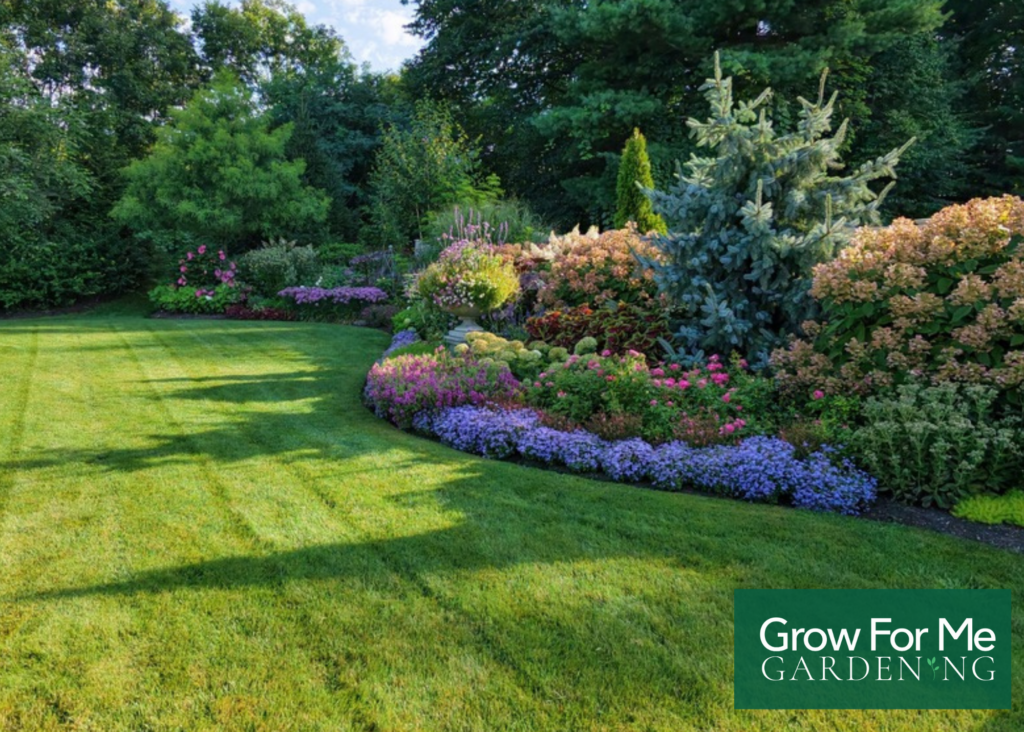
In one of our favorite borders, we have the blue foliage of a spruce, glossy green rose foliage, matte green hydrangea foliage, golden Spirea and arborvitae, and deep purple annual foliage.
Even when everything isn’t blooming at once, there’s still plenty of contrast.
Garden design tip: Take a picture of your garden bed when relatively few plants are flowering. Do you still see different colors, or does everything become one big mass of green?
Texture is one of those garden design elements that can be difficult to identify until you see an area where it isn’t working.
Our east border has a mix of fine evergreen needles, bold coleus foliage, smaller rose leaves, wispy grasses, rounded hydrangea flowers, tiny ageratum blooms, and larger flower forms.
The differences allow individual plants to stand out while still working together.
In another bed, we have the opposite problem.
Several perennials with similarly busy textures are planted next to each other. Individually, they’re beautiful plants. Together, there’s so much happening that nothing really gets a chance to shine.
The solution isn’t necessarily to buy new plants. We may simply rearrange what we already have so that bold foliage sits next to something finer or airier.
Garden design tip: If an area feels busy or muddy, look at the shapes and sizes of the leaves and flowers. You may need more contrast rather than more plants.
One of the easiest traps in garden design is planning almost entirely for summer.
We love summer flowers as much as anyone, but we want our garden to have something interesting happening throughout the year.
For us here in Zone 6A, that means asking what each area offers in:
This exercise quickly exposes gaps.
One of the beds we’re evaluating has plenty happening during summer and decent winter structure, but very little early-spring interest. That’s a clue that we don’t necessarily need to redesign the entire bed. We may simply need to add spring bulbs or another early-season plant.
In another border, we’re considering planting masses of miniature daffodils among the shrubs. They’ll give us early color, and by the time their foliage starts looking tired, the surrounding plants should be large enough to disguise it.
This might be the most important question.
Instead of looking at a garden bed and deciding you hate the whole thing, identify the specific problem.
Is there a hole in the shrub layer?
Too much of the same foliage?
Not enough color contrast?
Nothing blooming in spring?
A plant that’s impossible to access?
A maintenance problem?
One of our borders has a beautiful spring perennial that leaves a noticeable hole after it’s cut back. Rather than removing everything around it, we’re considering adding a medium-sized shrub that can provide structure once that perennial disappears.
In another bed, we planted a large rose toward the back of a deep border. As it matured, we realized that was a mistake. We can’t easily reach it to prune, deadhead, or even enjoy the fragrance.
The plant isn’t necessarily the problem. Its location is.
That’s an important distinction when you’re deciding what actually needs to change.
As we’re planning changes, we’re also thinking about repetition.
Repeating a plant, color, shape, or texture in different parts of a garden helps connect those areas visually.
For example, we’re considering moving one of our Pinky Winky Prime® hydrangeas so that it mirrors another one nearby. Instead of two unrelated specimens, the repeated hydrangeas would create a visual frame.
The same idea applies to foliage colors. If there’s dark burgundy foliage on one side of a pathway, repeating that color across the path can help the two beds feel connected.
You don’t need to plant everything in perfect symmetry. A little repetition simply gives your eye something familiar to follow through the garden.
This is something we’ve learned through experience: where you put a plant should also depend on how much attention it needs.
One of our garden beds is extremely deep. Anything planted toward the back needs to be something we can largely leave alone.
A rose that needs pruning and deadheading? Not ideal.
A perennial that gets cut to the ground once at the end of the season? Much easier.
We’re using this principle as we rethink our wildlife garden, where we’d like to add more native plants including asters, ironweed, prairie coneflower, Culver’s root, bee balm, and other plants that can intermingle naturally.
Instead of designing only around what looks good from the front, we’re considering how we’ll actually get into the bed and care for everything as the garden matures.
One of the biggest lessons we’ve learned is that finishing a garden bed doesn’t mean it has to stay that way forever.
Plants get bigger than expected. Conditions change. A combination doesn’t work. Something reseeds itself into a better location. Or your own taste simply evolves.
Our goal isn’t to get every garden bed “finished.”
It’s to keep paying attention.
Sometimes the answer is adding a shrub. Sometimes it’s moving a perennial three feet. Sometimes it’s repeating a plant we already love. And sometimes an entire section needs to come out so we can rethink the layers.
That’s part of the fun of gardening.
Hydrangeas play a major role throughout our garden, from creating large masses of summer flowers to adding structure and beautiful late-season color.
Our Hydrangea Handbook covers hydrangea identification, care, pruning, troubleshooting, and more to help you understand what your hydrangeas need and make better decisions about where and how to grow them.
The next time you’re looking at a garden bed and can’t quite figure out what’s wrong, don’t immediately start pulling plants.
Start with four questions:
Do I have enough color?
Do I have contrasting textures and forms?
Is there something interesting in every season?
What, specifically, would I change?
You may find that you’re much closer to a garden you love than you thought.
Want more on what goes well together in your garden? Check out our free Garden Pairings guide here!
Thanks for growing with us!

Join our gardening journey and grow alongside us. From seed starting to full garden tours, we share tips, inspiration, and the joy of growing beautiful spaces.
We respect your privacy and will never share your information. Thanks for growing with us!
Get seasonal tips, behind-the-scenes from our garden, and be the first to know what we’re planting, pruning, and loving.
As a thank you, we’ll send you our favorite tried-and-true plants — the ones we grow in our own garden.